Sunday, June 8, 2014

Tour of Butrint


I'm back and better than ever. I'm now in Rome and beginning work at the Vatican tomorrow at 8 am. As promised, I am completing the tour of Butrint now. This is going to be an extremely long post, but will be broken up with pictures. Still, if you're not big into history, don't stick around, but skip to my forthcoming post about how bad my travel day was from Greece to Rome.


We start at the very top of Butrint. This is the oldest part of the ancient city, occupied throughout the Hellenistic period, and is today off limits to all tour groups. We went up on one of our lunch breaks for a visit. This part of the site hasn't been dug too much, but it has revealed some interesting mosaics, now covered in dirt as to preserve them.


The first of these next three is the jail aka the love shack. This is where all the pottery is stored and where the ceramicists worked during the season. This is also where they found two five foot long poisonous snakes a couple years ago, and where I spent the first week of the season organizing. It was used as a tavern at some point, but is now off limits to all visitors. The second is a view of the lower plain below Butrint. Butrint has always been prized as a great location for timber, fishing and farm land, as well as strategically important in its proximity to Corfu, and this modern house still has a fishing system set up in their front 'lawn.'


The first is a photo of the forum from up above, the second is the Venetian castle where the remaining specialists worked and the third is our group heading off for the grand tour.


The first is the backside of the castle. The second is the Buthrotum version of the lion gate. The most famous lion gate is Mycenaean, but we have our own version. This is a very Hellenistic artistic design and was brought into popularity during the time known as the orientalizing period, when ancient Greece began to interact to a greater extent with Babylonia in the east, around the 8th century BCE. The third is a massive gate, leading to steps on the interior to the upper level. This gate is probably 13 feet tall, and has a significant place in the legends of the place. In the Aeneid book 3, Aeneas arrives at Buthrotum and describes it as a duplication of his beloved (and now destroyed) Troy. He arrives at a certain gate, where he meets Andromache, the wife of Hector (Hector was the greatest Trojan hero, slain by Achilles, the greatest Greek hero) who says that after the sack of Troy they fled and founded Buthrotum, modeling it after Troy. The way it probably worked out is Virgil visited Buthrotum, and then modeled the passage after what he found, but the Italians under Mussolini loved this part of the story. The last image is what you see if you rotate 180 degrees from the gate.


These next four images are from the basilica/cathedral at Butrint. Like most ancient sites, the population of Butrint eventually became composed of Christians. Some weren't too keen on the ancient monuments to pagan gods, leading to destruction of many artifacts and destruction of parts of the city. This cathedral sits on an ancient part of the city, but is a testament to the will of the people of Butrint. The third photo is a picture of dirt. The fourth photo is what is under that dirt, protected from tourists and the elements by a natural cover.


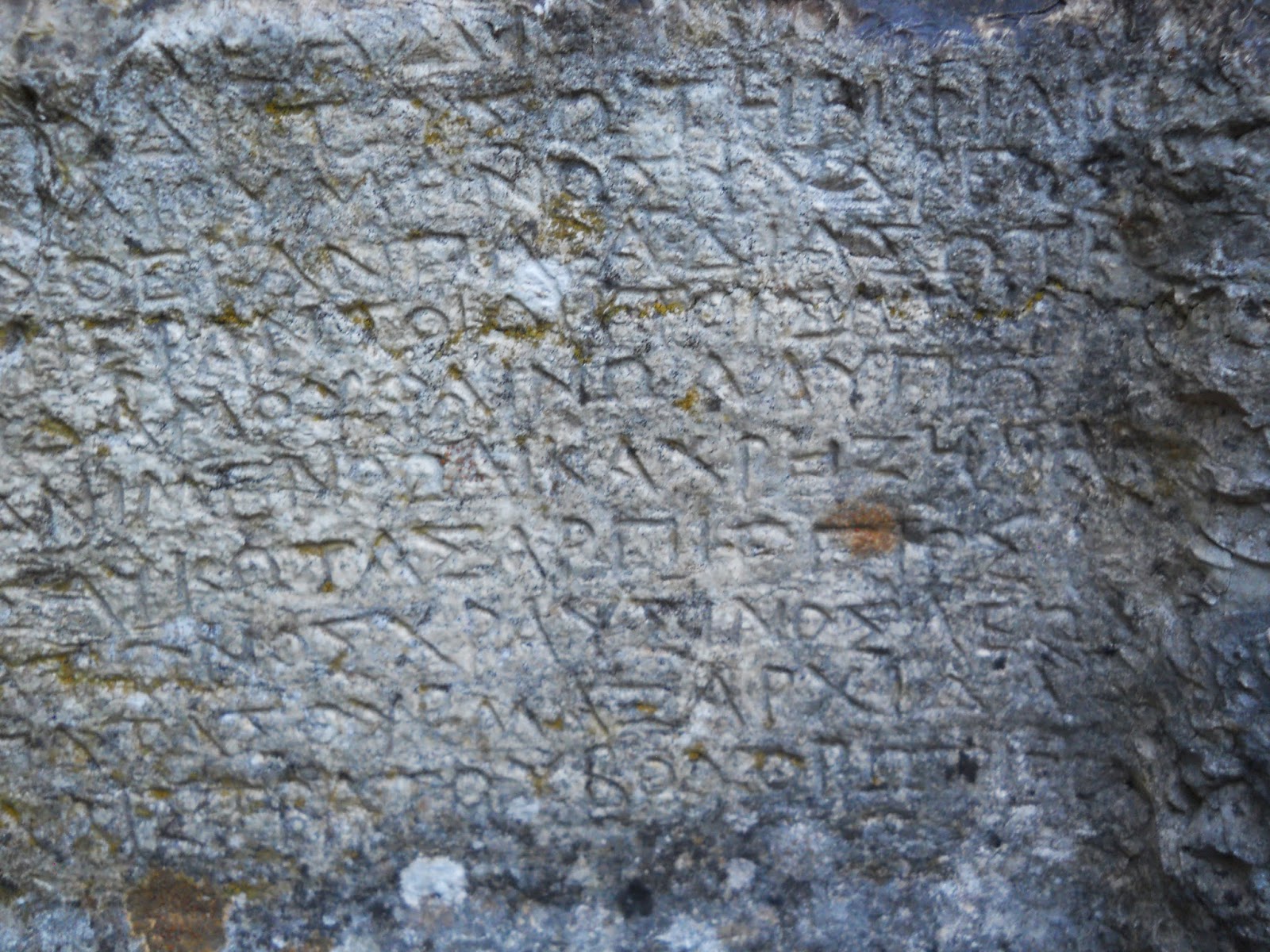
The first is our fearless leader, the second, third and fourth are photos of the baptistery. This is the second largest baptistery in the world and is decorated with the mural in the third picture. This is again another building created by Christian inhabitants. The last photo is a recent creation (circa 2011) that the Albanians, in all their brilliance, created. Around Butrint there were 200 hundred of these manumission stones (manumission=public freeing of slaves) describing various government offices, laws and other historical facts, as well as slaves who were publically freed. The Albanians, picked all these stones up, and threw them together in one wall, mortaring in bricks wherever there were holes. It's helping to preserve and present them, but it's ugly and really doesn't go with the site. TIA


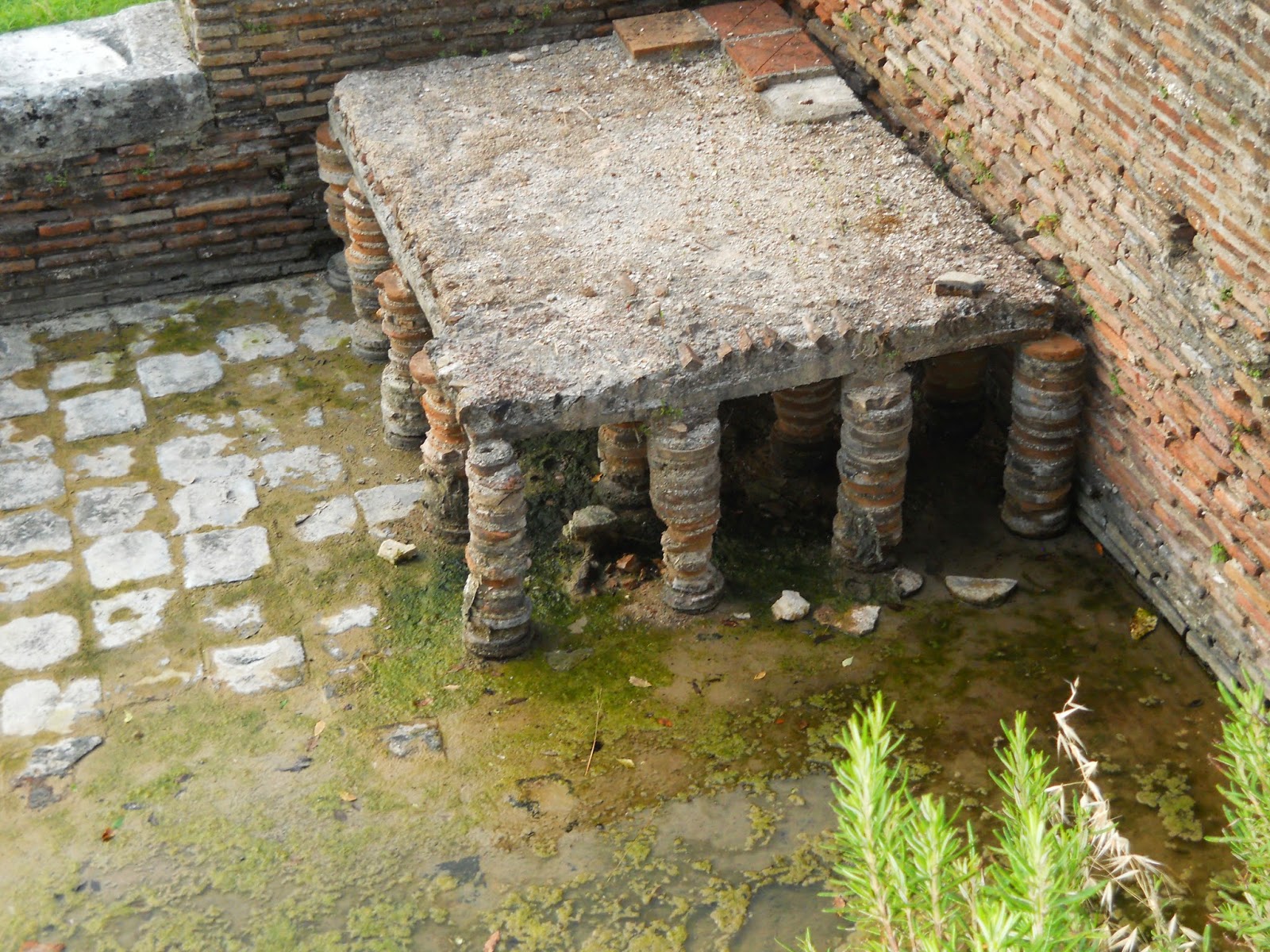
The first photo is none other than Augustus Caesar. Augustus is the most important figure in Roman history. He took over the collapsing Roman republic, and turned it into an Empire (read-dictatorship), successfully prolonging the lifespan of Rome. He personally poured numerous funds into Butrint, and made sure it functioned as a province. Other important figures are Julius Caesar, Cicero/Atticus, and Hadrian. Julius Caesar captured and stayed at Butrint prior to marching on Rome in 49 BCE (I will do a post where I run through Roman history, google it if you can't wait), Cicero may have visited Butrint, since one of his best friends, Atticus lived in and funded Butrint, and then the Emperor Hadrian visited Butrint on tour around 100 CE, prompting more building projects. All of these figures are found by name and statue at Butrint. The next photo is a friend I made. One of the dogs who roams (get it, Rome and roam!) had puppies, who happen to live at the archaeological portion of Butrint. We've visited them twice now, and I got a nice photo of one. The next is a Roman bath. The third is the tripartite building, where Professor Hernandez began work in 2005. Note the ground level above the gap on the right hand side. The ground above that gap was the ground level when Ugolini began excavations in the mid 20th century. Everything else was buried. The next is a picture of another Roman bath. Roman baths were heated by steam from below, and you can clearly see the two levels here. The final is a Roman theater.
And that's all there is too it. If you have questions or want to hear more about the site, let me know in the comments. Be sure to check out Professor Hernandez' forthcoming book if you want to hear more about the history of Butrint. There are a couple big surprises I can't share here, but let's just say his book is coming to be really excellent scholarship and shed light on the significance of this site, and yours truly helped in some of this research.

Thursday, June 5, 2014

Photos of the Site


Good news and bad news tonight. Good news is that I got a lot of cool photos and good information today, bad news is that I'm not going to be able to post it tonight. Some more of the team is leaving tomorrow and I leave on Saturday, so I'm going to be selfish and enjoy the time with the group. Tomorrow will probably also be a short post, as I'll be printing materials and prepping for travel, but on Sunday I should be able to deliver on my promise of a tour of Butrint, as well as photos of Rome, as I arrive there on Sunday afternoon. They say live for the experience, and I'm going to get off the computer and enjoy my time with these people before we say our goodbyes. As I'm not completely heartless, and I appreciate my readers (as well as leaving cliff hangers) I will leave you with a taste of the photos from Butrint.


Wednesday, June 4, 2014

View of the Castle and More Visitors

So this is the view of the castle where we work. I'm standing on the upper battlements, looking back at the tower. This was where Ugolini worked and lived (he rebuilt the tower first) during his archaeological research in the 40s. It's a cramped space, but the three ND students work outside on the lower level during the day, freeing up some space, but facing the heat and bird projectiles (I got pooped on today by one of the swallows). We've finished all 7500 shells, and been moved first to fresco and now on to mortar. It's pretty cool to be allowed to analyze and play with the tiles that made up floors and murals in the ancient houses, and we're seeing some pretty neat colors and designs. This experience has really been hands on, an aspect that I  have grown to appreciate. Professor Hernandez is meticulous; he expects every object, from the biggest chunk of marble to the smallest piece of bronze to be catalogued, with weight, size and description provided. This approach can be tedious, especially when we had to look at hundreds of identical iron nails, but it's going to produce an excellent work and really thorough scholarship, and we as students are right in the thick of it.

We've had one more member join our team, and a new family come to Tani's to stay. Danny, who's last name I can't remember, arrived yesterday from Britain. He will be here till Monday, and will act as an architectural conservature, basically working to preserve as much of the site as possible. He's an older gent, but he's already regalled us with some enjoyable stories. Two older tourists have arrived at Tani's on vacation. Turns out they are from Denmark, and they perked up when I told them that my mother still has family on Bornholm. The husband is extremely interested in Cicero, so he asked for a Roman history lesson, which I provided to the best of my ability and in return he bought me a beer. While my professors might not be thrilled to learn I'm exchanging my academic knowledge for alcohol, it was really a thrill to encounter an individual who ate up the soap opera that is the transition from Republic to Principate, and who shared my love for the Classics. Even in a small bar in a European country, Classics unites people across nationalities. Never a dull day in Albania!

Be sure to tune in tomorrow for pictures of Butrint, the site we work at. We're staying after work for a private tour of the site, lead by Professor Hernandez himself. Only my parents will be allowed to see some of the photos, as not everything is public knowledge yet, but what I can share with my readers, I will. Love to you all.

Monday, June 2, 2014

Group Photo

Short post today. Several people requested photos of the group, so this is one of everyone, minus myself who's taking the photo. From left to right:

Back Row-
Professor David Hernandez- Professor at Notre Dame and Lead Researcher and Organizer of the Project
Chris- Undergraduate at ND, working on shells
Giacomo- Pottery Specialist from Italy
Alexandra (in the way back)- Small Finds Specialist from Hungary
Anna (in the green)- Artist responsilbe for detailing all the finds
Illear (pronounced ill-ear)- Local Albanian workman
Mirgen (aka Genni)- Local Albanian specialist working on tiles

Middle Row-
Anna (in the shorts)- Conservation specialist from Germany
Elena (in the green in front of Giacomo)- Coin Specialist from Italy
Erin- PHd student at UC Berkeley working on Marble
Michael- Conservation Specialist from the Netherlands

Front Row-
Gloria- Pottery Specialist from Italy
Nadia- Pottery Specialist from Italy
Tania- Glass specialist from Italy
Karilyn- Grad student from ND, working on shells

A smaller team than most years, but it's the final stages of the project and we're all studying material instead of unearthing it. People start leaving on Wednesday and then I leave Saturday afternoon from Albania, so this is the last hurrah at Butrint.

Sunday, June 1, 2014

A Tour of Ksamil

Happy Sunday everyone! I went to mass again today and was walked in to find a priest in the sanctuary! We were able to have a full mass today (minus the homily) from a priest from Corfu. He can read Albanian, he speaks Italian and he did a fairly nice mass. After a couple weeks away from the Eucharistic, it was a blessing to be able to celebrate it again. Makes me appreciate having being able to celebrate communion at mass every Sunday, something often taken for granted. God is good!

The party went really well last night. As could be expected, I was the life of the party. The two groups started pretty divided, and it felt like high school all over again, with one clique in one corner and the other in the another. We were like that for the first half an hour, and then a song finally came up that I could dance to. As some of you may know, I love to dance. It wasn't long before the two groups had merged to dance the chicken dance, Gangam style, and eventually my personal favorite and specialty, Twist and Shout done in the vein of Ferris Bueller. For those of you on facebook, brace yourselves because videos and photos are probably on their way to the world wide web as soon as everyone gets internet. A good time was had by all, and I had several people come up and tell me how much fun they had because of me. People keep predicting I'll change when I go places, but as I've said, I've found who I am and people love me for being me. I am who I am and that's all that I am.

It's too windy for the beach today, so I've got some time on my hands and some photos on my computer, so I thought I would give a mini tour of Ksamil, the town where I'm staying, as well as several photos of Sarande, the adjacent 'city' where the Catholic church and ferry are found. Without further ado, the pictures. First Sarande


The first photo is from a truck in Sarande. There are no regulations in Albania for many things, including auto care. This car is street legal and probably driven, presenting a danger to both its driver and other people in the area. As much as inspection costs time and money, this is the alternative. The second is the soccer stadium in Sarande, the national sport. The third is one of the streets, where they sell mussels on one side of the street and fruit on the other, all while trying to maintain a two lane road and pedestrian walkway. The fourth is Caesars palace, or at least the version found in Albania.

These two are photos on the bus ride back to Ksamil. Albania is still big into farming and agriculture, with many people dependent on grazing sheep and goats and growing crops to survive. The other 'big' industry is mussel farming, which can be seen in the second photo. As a result, the seafood is always cheap and plentiful, which suits me just fine.


Lots to talk about with these photos. The first is a soccer field near where we stay. It's a private field, as a wealthy Albanian rents it out for leagues and games, but we'll probably play against the locals sometime before we leave. The second is the local high school, where our friend from the peace corps teaches English. The third is a view from the beach. According to the locals, there used to be a restaurant on the island, but they didn't have the correct paperwork, so the government sent some people over and blew the place to bits, leaving it in it's current state. The government doesn't get involved in much, but when they do they rule with a relatively iron fist. The fourth is the 'coliseum' a hotel built by a foreign businessman. Albania has the natural setting to attract tourists, especially our area, but the infastructure doesn't support that kind of lifestyle yet. This businessman built the hotel to make money off the tourists, but it stands empty for most of the year, with a couple of the rooms occasionally rented out during the summer. Thus is the condition of many buildings here. The fifth is the mosque in town. They have the call to prayer five times a day, but I haven't seen too many muslims, and the locals don't know how many go. The sixth is another failed construction project, or perhaps a work in progress. People start projects here, and then add some whenever they get the money. This process could take a year, or five years, and until they're done they dot the city with half finished buildings. The next three are three corners of the view from the roof of the house. The final is the Albanian method of heating: solar panels! Everyone uses them, and they work really well provided you have sun. If you don't you are guaranteed a cold shower. Therefore, we always shower during the day and hope for sunshine. I'm going to go grab dinner then skype the family, so be well and talk to you all later.